

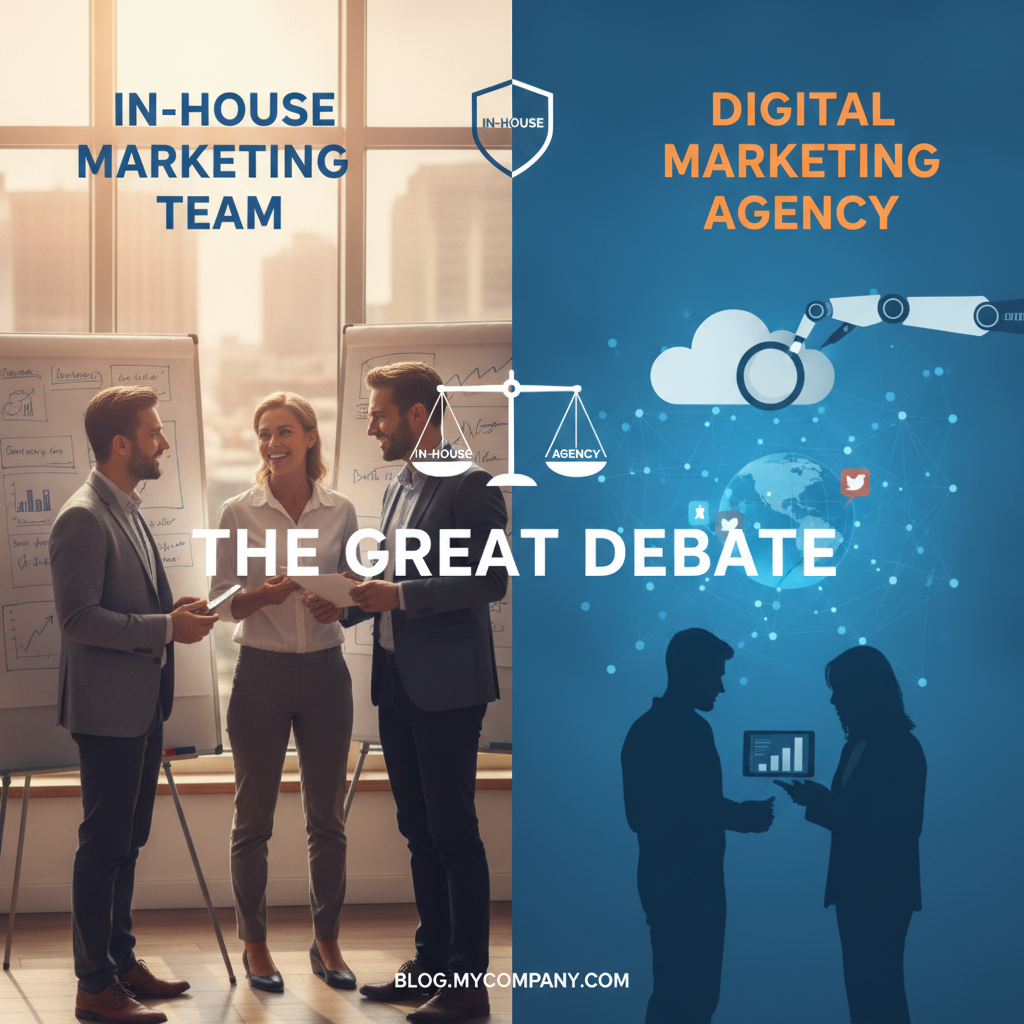
In-House Marketing Team vs. Digital Marketing Agency: Which is Right for Your Business?
In today’s competitive digital landscape, having a robust marketing strategy is no longer optional – it’s essential for survival and growth. As businesses strive to connect with their target audience online, a critical decision emerges: should you build an internal marketing team or partner with a specialized digital marketing agency? Both approaches offer unique benefits and drawbacks. Understanding these differences is key to making an informed choice that aligns with your business goals, resources, and long-term vision.
Let’s dive into a comprehensive comparison to help you decide.
The In-House Marketing Team: Control & Cohesion
An in-house marketing team consists of dedicated employees working directly within your company. They are fully immersed in your brand culture, products, and services.
Pros of an In-House Marketing Team:
- Deep Brand Knowledge: Your team lives and breathes your brand daily, leading to consistent messaging and a profound understanding of your company’s values and unique selling propositions.
- Direct Control & Communication: You have immediate oversight and can make quick decisions, ensuring campaigns perfectly align with current business objectives. Communication is often seamless and face-to-face.
- Company Culture Integration: The team is fully integrated into your company culture, fostering strong internal relationships and a shared sense of purpose.
- Long-Term Strategy Alignment: With a permanent team, it’s easier to develop and maintain long-term marketing strategies that evolve with the business.
- Cost-Effective (in the long run for large businesses): While initial setup costs can be high, for extensive, ongoing marketing needs, an established in-house team might prove more cost-efficient than continuous agency fees over many years.
Cons of an In-House Marketing Team:
- Limited Expertise: It’s challenging to hire individual marketers who are experts in every digital marketing discipline (SEO, PPC, social media, content, web development, email marketing, analytics). This often leads to skill gaps.
- High Overhead Costs: Beyond salaries, you’re responsible for benefits, office space, equipment, software licenses, training, and professional development.
- Recruitment Challenges: Finding and retaining top talent with diverse skill sets can be time-consuming and expensive.
- Risk of Burnout & Stagnation: A small team can get overwhelmed, and without external input, ideas might become stale or lack a fresh perspective.
- Access to Tools: Agencies often have access to a wider range of premium tools and software that might be too expensive for an individual company to license.
The Digital Marketing Agency: Expertise & Efficiency
A digital marketing agency is an external company specializing in various online marketing disciplines. Businesses outsource their marketing efforts to these experts.
Pros of a Digital Marketing Agency:
- Diverse & Specialized Expertise: Agencies house a team of specialists in every niche of digital marketing. You gain access to SEO experts, PPC managers, content strategists, social media gurus, and web developers all under one roof.
- Scalability & Flexibility: Agencies can quickly scale their efforts up or down based on your evolving needs, without the hassle of hiring or laying off employees.
- Cost-Effective (for specific projects or smaller businesses): You only pay for the services you need, avoiding the fixed overhead costs of salaries, benefits, and equipment.
- Fresh Perspectives & Innovation: Agencies work with multiple clients across various industries, bringing a wealth of diverse experiences, innovative ideas, and knowledge of the latest trends and technologies.
- Access to Advanced Tools & Data: Agencies often invest in expensive industry-leading software, analytics platforms, and competitive research tools that might be cost-prohibitive for individual businesses.
- Accountability & Performance-Driven: Agencies are typically performance-driven, with clear KPIs and reporting structures, making it easier to track ROI.
Cons of a Digital Marketing Agency:
- Less Direct Control: While you guide the strategy, the day-to-day execution is handled externally, which might feel less hands-on for some businesses.
- Onboarding Time: It takes time for an agency to fully understand your brand, target audience, and specific business goals.
- Communication Gaps: Potential for miscommunication if expectations are not clearly set or if there isn’t a dedicated point of contact.
- Multiple Clients: Agencies serve multiple clients, so you might not always feel like their sole focus, although dedicated account managers aim to mitigate this.
- Cost for small, ongoing tasks: For very minor, repetitive tasks, an agency’s hourly rate might seem high compared to an in-house team member.
Factors to Consider When Making Your Choice
The best choice isn’t universal; it depends heavily on your unique situation:
- Budget: Can you afford the significant ongoing costs of salaries, benefits, and infrastructure for an in-house team, or is a project-based or retainer fee for an agency more suitable?
- Business Size & Goals: A startup might benefit from an agency’s expertise without the initial overhead, while a large enterprise might opt for a hybrid model or a fully in-house team for specific functions.
- Required Expertise: Do you need highly specialized skills across multiple digital disciplines, or is your marketing scope narrower?
- Timeframe: Do you need immediate results or have a long-term strategy that can be built over time? Agencies can often kickstart campaigns faster.
- Company Culture: How important is it to have marketing fully integrated into your internal operations versus leveraging external partnerships?
The Hybrid Approach: Best of Both Worlds?
Many businesses find success with a hybrid model, employing a small in-house team for day-to-day operations, brand messaging, and internal coordination, while outsourcing specialized tasks like SEO, PPC, or complex web development to an agency. This approach allows for deep brand integration while leveraging expert external knowledge for specific, high-impact areas.
Conclusion
Ultimately, the decision between an in-house marketing team and a digital marketing agency is a strategic one that requires careful consideration of your business’s current needs, future goals, and available resources.
An **in-house team** offers unparalleled brand immersion and control, ideal for businesses with consistent, large-scale marketing needs and the budget to support it. A **digital marketing agency** provides diverse expertise, scalability, and fresh perspectives, making it an excellent choice for businesses seeking specialized skills, efficiency, and flexibility without the burden of extensive overhead.
Evaluate your priorities, weigh the pros and cons, and consider if a hybrid model might offer the perfect balance to propel your business forward in the digital age.
For more details about digital marketing agencies and web design and development services, you can contact IIS E-Solutions, one of the leading agencies in Lebanon and Detroit, with proven experience in Doha, Qatar, Dubai, UAE, and Jeddah and Riyadh, Saudi Arabia. IIS E-Solutions provides comprehensive digital marketing solutions, including SEO, paid advertising, and professional web design and development services tailored to help businesses grow online.
Phone number: +961 3 707754