

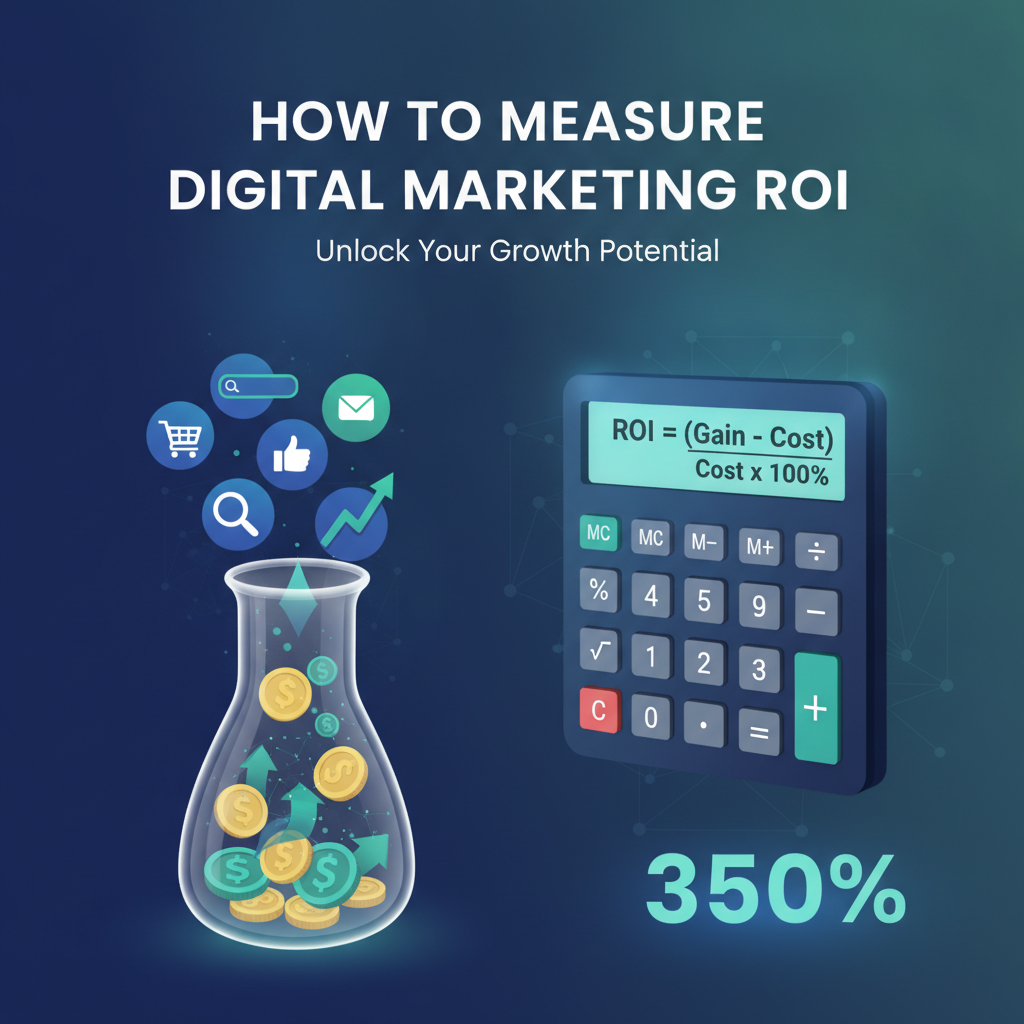
How to Measure Digital Marketing ROI: A Comprehensive Guide for Business Growth
In the dynamic world of digital marketing, it’s easy to get caught up in the latest trends and shiny new platforms. But at the end of the day, every marketing effort needs to contribute to your business’s bottom line. This is where Digital Marketing ROI (Return on Investment) comes in. Understanding and accurately measuring your ROI isn’t just good practice; it’s essential for sustainable growth, optimizing your strategies, and proving the value of your marketing spend.
What is Digital Marketing ROI?
Simply put, Digital Marketing ROI measures the profit or loss generated relative to the cost of your digital marketing campaigns. It answers the fundamental question: “For every dollar I spend on digital marketing, how many dollars do I get back?” A positive ROI means your campaigns are profitable, while a negative ROI indicates areas that need re-evaluation.
Why is Measuring Digital Marketing ROI Crucial?
* **Justify Marketing Spend:** Demonstrate the value of marketing to stakeholders and secure future budgets.
* **Optimize Campaigns:** Identify what’s working and what isn’t, allowing you to reallocate resources for better performance.
* **Make Data-Driven Decisions:** Move beyond guesswork and base your strategies on tangible results.
* **Improve Accountability:** Hold your marketing team or agency accountable for achieving measurable outcomes.
* **Identify Growth Opportunities:** Pinpoint successful channels and campaigns to scale up.
Key Metrics to Track for ROI Measurement
While the ultimate goal is profit, various metrics contribute to and indicate the success of your digital marketing efforts.
* **Website Metrics:**
* Conversion Rate (purchases, lead forms, downloads)
* Traffic Sources
* Average Order Value (AOV)
* Customer Lifetime Value (CLV)
* **Social Media Metrics:**
* Engagement Rate (likes, shares, comments)
* Referral Traffic to your website
* Lead Generation via social platforms
* **Email Marketing Metrics:**
* Open Rate and Click-Through Rate (CTR)
* Conversion Rate from emails
* List Growth Rate
* **Paid Advertising Metrics (PPC, Social Ads):**
* Cost Per Click (CPC)
* Cost Per Lead (CPL)
* Cost Per Acquisition (CPA)
* Return on Ad Spend (ROAS)
* **SEO Metrics:**
* Organic Traffic
* Keyword Rankings
* Organic Conversions
Calculating Digital Marketing ROI: The Formula
The basic formula for calculating ROI is:
**ROI = (Net Profit from Digital Marketing – Digital Marketing Costs) / Digital Marketing Costs * 100%**
Let’s break it down:
* **Net Profit from Digital Marketing:** This is the revenue generated directly from your digital marketing efforts minus the cost of goods sold (if applicable).
* **Digital Marketing Costs:** This includes all expenses related to your campaigns: ad spend, agency fees, software subscriptions, content creation, employee salaries, etc.
**Example:**
If a campaign generated $10,000 in revenue, the product cost was $2,000, and the marketing cost was $1,000:
Net Profit = $10,000 (Revenue) – $2,000 (Product Cost) = $8,000
ROI = ($8,000 – $1,000) / $1,000 * 100% = ($7,000 / $1,000) * 100% = 700%
This means for every $1 spent, you gained $7 in profit.
Steps to Measure Digital Marketing ROI Effectively
1. Define Clear Goals and KPIs (Key Performance Indicators):
Before launching any campaign, establish what you want to achieve (e.g., increase sales by 15%, generate 500 leads, reduce CPA by 10%). Link these goals directly to revenue or measurable value.
2. Track All Digital Marketing Costs:
Be meticulous. Include ad spend, software licenses, agency fees, content creation costs, salaries of marketing personnel, and any other related expenses.
3. Accurately Attribute Revenue:
This is often the most challenging part. Use analytics tools to understand which marketing touchpoints led to a conversion.
* **First-Touch Attribution:** Credits the first interaction a customer had with your brand.
* **Last-Touch Attribution:** Credits the final interaction before conversion (most common and easiest).
* **Multi-Touch Attribution Models:** Distribute credit across various touchpoints (linear, time decay, position-based). Google Analytics and other platforms offer these advanced models.
4. Implement Robust Tracking Tools:
* **Google Analytics 4 (GA4):** Essential for website traffic, conversions, and user behavior.
* **Google Tag Manager (GTM):** Simplifies tracking code implementation.
* **CRM Systems:** (e.g., Salesforce, HubSpot) For tracking leads through the sales funnel and attributing revenue.
* **Ad Platform Analytics:** (e.g., Google Ads, Meta Ads Manager) For campaign-specific performance.
5. Calculate and Analyze Your ROI:
Regularly apply the ROI formula to individual campaigns, channels, or your overall digital marketing efforts. Don’t just look at the number; understand *why* it’s positive or negative.
6. Optimize and Refine:
Use your ROI insights to make informed decisions.
* Increase investment in high-ROI campaigns.
* Adjust or pause underperforming campaigns.
* Test new strategies based on learned data.
* Continuously refine your attribution models for greater accuracy.
Tools to Help Measure Digital Marketing ROI
* **Google Analytics 4:** For comprehensive website and app tracking.
* **CRM Software:** (e.g., HubSpot, Zoho CRM, Salesforce) For lead management and sales attribution.
* **Google Ads & Meta Ads Manager:** Built-in analytics for paid campaigns.
* **SEMrush / Ahrefs:** For SEO performance and competitive analysis.
* **Marketing Automation Platforms:** (e.g., Mailchimp, ActiveCampaign) Often include robust reporting features for email and lead nurturing.
* **Custom Dashboards:** (e.g., Google Data Studio / Looker Studio, Tableau, Power BI) For consolidating data from multiple sources.
Common Challenges and How to Overcome Them
* **Data Silos:** Integrate your data sources (CRM, analytics, ad platforms) for a holistic view.
* **Attribution Complexity:** Start with a simpler model (last-touch) and gradually explore multi-touch models as your expertise grows.
* **Long Sales Cycles:** Focus on intermediate KPIs like lead quality and engagement before a direct sale occurs.
* **Lack of Clear Goals:** Always define SMART (Specific, Measurable, Achievable, Relevant, Time-bound) goals upfront.
Conclusion
Measuring Digital Marketing ROI isn’t an option; it’s a necessity for any business looking to thrive in the digital landscape. By systematically tracking costs, attributing revenue, and analyzing performance, you can turn your marketing budget into a powerful engine for growth. Embrace data-driven decision-making, and you’ll not only justify your marketing efforts but also unlock new levels of success.
For more details about digital marketing agencies and web design and development services, you can contact IIS E-Solutions, one of the leading agencies in Lebanon and Detroit, with proven experience in Doha, Qatar, Dubai, UAE, and Jeddah and Riyadh, Saudi Arabia. IIS E-Solutions provides comprehensive digital marketing solutions, including SEO, paid advertising, and professional web design and development services tailored to help businesses grow online.
Phone number: +961 3 707754